 In February 2022, Tesla announced Austin as the new site for a gigafactory manufacturing facility and headquarters. Austin Community College (ACC) quickly established a relationship with Tesla, the City of Austin, and Travis County to create long-term workforce development goals. Rather than treat Tesla as a tenant or traditional industry partner, ACC envisioned a deeper collaboration – one rooted in long-term talent development, shared infrastructure, and first-of-its-kind programming.
Together, ACC and Tesla created a mutually beneficial partnership model that went beyond the classroom to create innovative programming for the region. Foundational components to the agreement included:
- Equipment donations and classroom renovations
- Access to Texas Workforce Commission funding
- Articulated courses
- Lease agreement
- Adjunct instructor access
- Flexible Relationship Agreement (see below)
Leveraging the workforce funding ecosystem in Texas through the Texas Workforce Commission has been fundamental to the rapid expansion and success of the program. Focusing on workforce outcomes allows for the program structure to be malleable to the needs of both the business and the institution.
With clean energy jobs growing at more than double the rate (4.9%) of job growth in the rest of the economy (2.0%), the demand for a skilled workforce is on the rise. In 2024 alone, an anticipated 149,000 new jobs will be created in this sector. This growth presents numerous opportunities for workforce programming, bolstered by substantial federal and state funding.
To capitalize on this momentum, it is essential to effectively connect available resources with industry partners. Braiding the right funding with the right partners can significantly impact the quality and sustainability of new programs.
Austin Community College has successfully partnered with Tesla and the Texas Workforce Commission to train thousands of community members and employees. In this collaboration, Austin Community College acts as an intermediary, linking industry, government funding, and education.
Tesla and ACC worked closely to understand Tesla’s workforce needs while leveraging the college’s academic expertise. After thorough industry collaboration, the selected occupations were registered with the Texas Workforce Commission. The Texas Workforce Commission provided:
- 2021: $1.8M including $550k in equipment
- 2023: $2M including $150k in equipment
Additional Call-outs for Success
Program delivery: While technical programming remained consistent with industry standards, the delivery of the programming was built to seamlessly integrate into students/apprentice’s schedules. Allowing all participants to get their on-the-job training components and educational criteria completed in a 40-hour work week. This manifested in either a front-loaded schedule where students attended between 1-16 weeks of classes onsite at ACC, or evening courses.
Employer contributions: Tesla paid students their regular hourly wage regardless of completing their work on-the-job or in the classroom, ensuring students were able to be accountable and present for both components.
Expanded support services and courses: As the Tesla & ACC partnership grew and the number of student participants increased, so did the demand for wraparound services to address emerging challenges. One notable example is the Manufacturing Development Program (MDP), which enrolls recent high school graduates into a 7-week training bootcamp at ACC. Many of these students entered the program without prior work experience, bank accounts, or basic life skills—such as packing a nutritious lunch or navigating professional expectations.
In response, ACC developed an “Adulting 101” course to provide foundational life and workplace skills. These practical lessons proved essential to student success and workforce readiness, and they were not part of the program prior to this targeted intervention.
Download the Tesla START and MDP – COURSE DESCRIPTIONS (PDF).
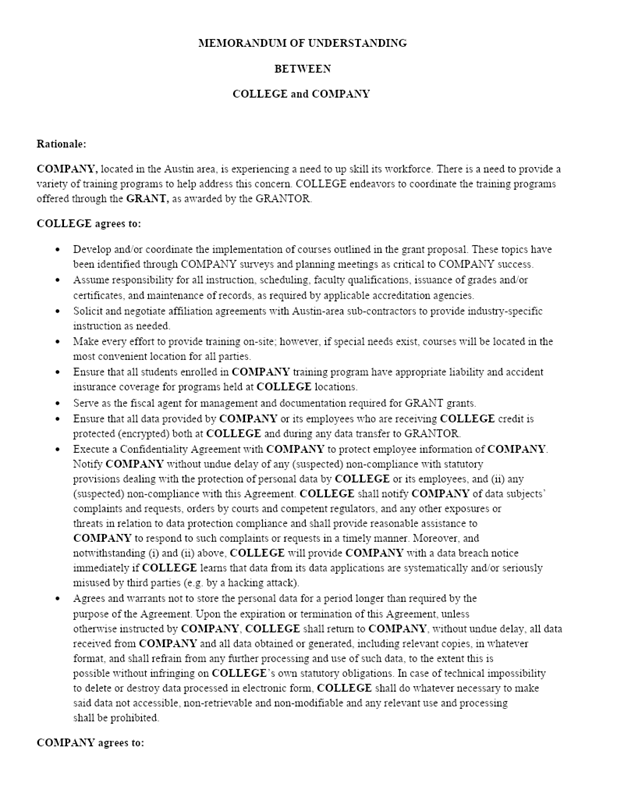
Download a sample MEMORANDUM OF UNDERSTANDING (PDF).