

Introduction
The rapid growth of the EV industry has positioned advanced manufacturing as a pillar of developing a clean energy economy. As automakers transform existing facilities and build new EV-dedicated plants, the industry is undergoing a generational shift in both production methods and workforce needs. As a result, reskilling and upskilling America’s workforce has become essential to supporting the rapid growth of this sector.
EV manufacturing encompasses a range of processes, including vehicle assembly and the production of essential components, such as batteries, drivetrains, and electronics. These processes may be vertically integrated, where all elements are produced under one roof or assembled across multiple manufacturing facilities globally. Regardless of the approach, EV production demands a diverse and specialized workforce, with skill sets ranging from engineering and automation to advanced manufacturing techniques.
For colleges located near EV manufacturing plants, there is a significant opportunity to build long-term partnerships by aligning apprenticeship programs with the hiring and retention needs of local employers. Developing flexible apprenticeship programs can be a powerful strategy to meet this demand while creating pathways to high-quality, future-driven careers for students.
While this guide focuses on electric vehicles, it is important to recognize that technology advancements are accelerating innovation in other electric transportation sectors, including planes, boats, and other transportation solutions. Colleges that invest in workforce development for EV manufacturing today will be well-positioned to support broader advancements in electric transportation in the future.
Getting the conversation started
Relationship building is the backbone of successful apprenticeships. Developing and acquiring robust curriculum is not enough to deliver successful programming. Colleges should proactively identify contacts within the EV industry to address workforce challenges and adapt to their evolving needs.
Probing questions to ask potential partners:
- What are the immediate and long-term hiring needs of your company? What are the skills or certifications necessary for these roles?
- What are the retention rates of your most in-demand roles?
- Do you have regional hiring requirements you must meet (is there a minimum quota for local hiring)?
- Where will you be hiring most of your skilled workforce from?
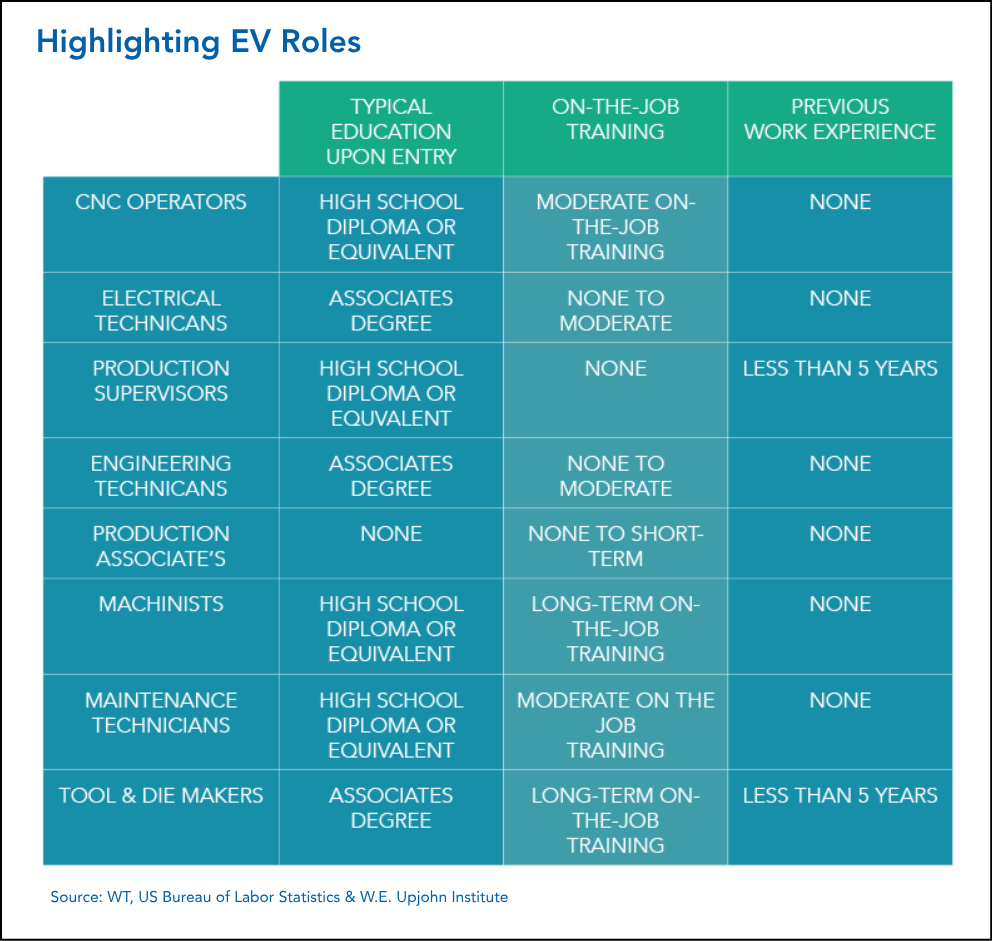
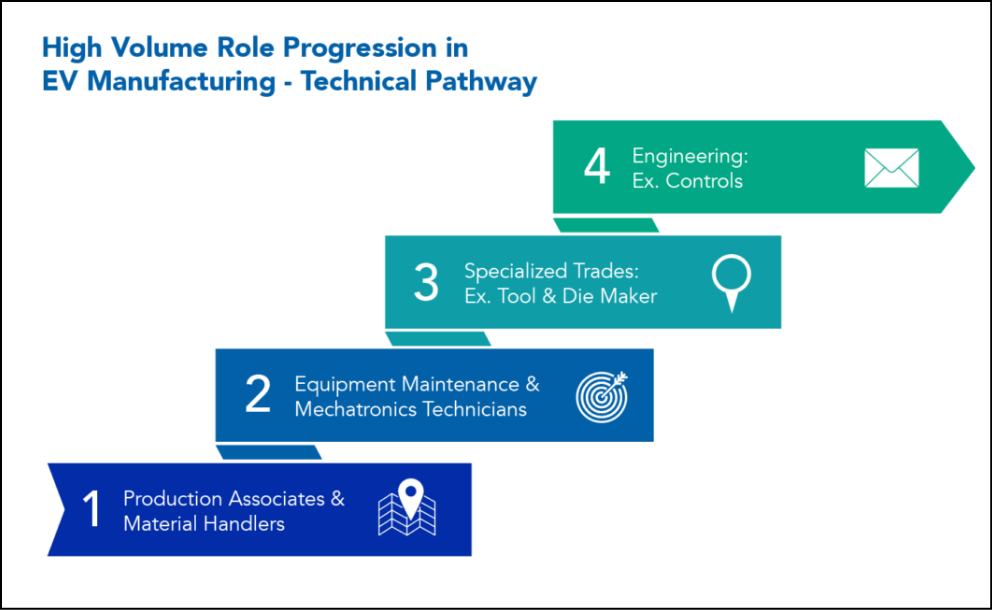
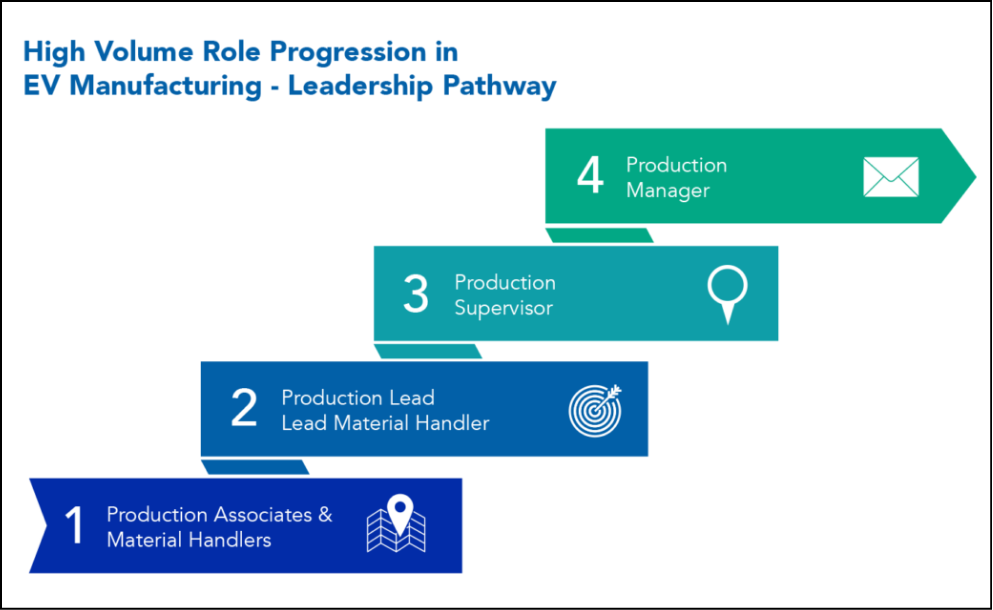
- What does the promotion pathway look like for your skilled trades roles? (See example)
- What are your pay ranges?
- Do you have someone dedicated to the success of your workforce programming?
- Do you have sufficient training space on-site or are you looking for partnership?
These questions are meant to clarify the company’s expectations for growth and help you understand where you can find sustainable long-term opportunities to train current and future employees.

Austin Community College & Tesla Inc.
 In February 2022, Tesla announced Austin as the new site for a gigafactory manufacturing facility and headquarters. Austin Community College (ACC) quickly established a relationship with Tesla, the City of Austin, and Travis County to create long-term workforce development goals. Rather than treat Tesla as a tenant or traditional industry partner, ACC envisioned a deeper collaboration – one rooted in long-term talent development, shared infrastructure, and first-of-its-kind programming.
Together, ACC and Tesla created a mutually beneficial partnership model that went beyond the classroom to create innovative programming for the region. Foundational components to the agreement included:
- Equipment donations and classroom renovations
- Access to Texas Workforce Commission funding
- Articulated courses
- Lease agreement
- Adjunct instructor access
- Flexible Relationship Agreement (see below)
Leveraging the workforce funding ecosystem in Texas through the Texas Workforce Commission has been fundamental to the rapid expansion and success of the program. Focusing on workforce outcomes allows for the program structure to be malleable to the needs of both the business and the institution.
With clean energy jobs growing at more than double the rate (4.9%) of job growth in the rest of the economy (2.0%), the demand for a skilled workforce is on the rise. In 2024 alone, an anticipated 149,000 new jobs will be created in this sector. This growth presents numerous opportunities for workforce programming, bolstered by substantial federal and state funding.
To capitalize on this momentum, it is essential to effectively connect available resources with industry partners. Braiding the right funding with the right partners can significantly impact the quality and sustainability of new programs.
Austin Community College has successfully partnered with Tesla and the Texas Workforce Commission to train thousands of community members and employees. In this collaboration, Austin Community College acts as an intermediary, linking industry, government funding, and education.
Tesla and ACC worked closely to understand Tesla’s workforce needs while leveraging the college’s academic expertise. After thorough industry collaboration, the selected occupations were registered with the Texas Workforce Commission. The Texas Workforce Commission provided:
- 2021: $1.8M including $550k in equipment
- 2023: $2M including $150k in equipment
Additional Call-outs for Success
Program delivery: While technical programming remained consistent with industry standards, the delivery of the programming was built to seamlessly integrate into students/apprentice’s schedules. Allowing all participants to get their on-the-job training components and educational criteria completed in a 40-hour work week. This manifested in either a front-loaded schedule where students attended between 1-16 weeks of classes onsite at ACC, or evening courses.
Employer contributions: Tesla paid students their regular hourly wage regardless of completing their work on-the-job or in the classroom, ensuring students were able to be accountable and present for both components.
Expanded support services and courses: As the Tesla & ACC partnership grew and the number of student participants increased, so did the demand for wraparound services to address emerging challenges. One notable example is the Manufacturing Development Program (MDP), which enrolls recent high school graduates into a 7-week training bootcamp at ACC. Many of these students entered the program without prior work experience, bank accounts, or basic life skills—such as packing a nutritious lunch or navigating professional expectations.
In response, ACC developed an “Adulting 101” course to provide foundational life and workplace skills. These practical lessons proved essential to student success and workforce readiness, and they were not part of the program prior to this targeted intervention.
opens in a new windowDownload the Tesla START and MDP – COURSE DESCRIPTIONSopens PDF file (PDF).
opens in a new windowDownload a sample MEMORANDUM OF UNDERSTANDINGopens PDF file (PDF).


Promising Practices: School Bus Initiative
The opens in a new windowWorld Resources Institute’s Electric School Bus (ESB) Initiative demonstrates how a fleet transition can double as a workforce development strategy. By committing to electrify the entire U.S. school bus fleet by 2030, WRI is helping normalize electric mobility for an entire generation of students while creating demand for skilled workers across the EV ecosystem.
School bus fleets are particularly well-suited for electrification because they operate on predictable routes and park in centralized depots, allowing for convenient overnight charging during long idle periods.
For community colleges and apprenticeship sponsors, ESB offers an entry point into EV workforce programming. Transitioning thousands of school buses requires technicians trained in maintenance and safety, electricians and charging-infrastructure specialists, and additional workers across the supply chain. This localized demand makes school districts natural partners for colleges in designing apprenticeship models, while also providing youth exposure to EV technology in their daily lives.
Key elements that align with an apprenticeship model include:
- Clear local demand: School districts nationwide are receiving support to electrify fleets, creating predictable job opportunities in maintenance, charging, and manufacturing.
- Transferable skillsets: The same skills developed for school bus electrification like battery servicing, charger installation, and fleet management, directly translate to broader EV apprenticeship pathways.
- Education & industry partnerships: The initiative encourages collaboration among school districts, utilities, OEMs, and community colleges, emulating best practices in apprenticeship development.
Stay Connected
Conferences & Trade Shows
- opens in a new windowElectric Vehicle Symposium & Exhibition (EVS web address changes yearly)
- opens in a new windowThe Battery Show North America
- opens in a new windowACT Expo (Advanced Clean Transportation)
- opens in a new windowAdvanced Automotive Battery Conference (AABC)
- opens in a new windowIEEE Transportation Electrification Conference
Newsletters & Industry News
- opens in a new windowElectrek
- opens in a new windowInsideEVs
- opens in a new windowAutomotive News
- opens in a new windowCleanTechnica
- opens in a new windowThe Drive
- opens in a new windowBattery Industry News
Government, Associations & Workforce Groups
- opens in a new windowU.S. Department of Energy — Vehicle Technologies Office
- opens in a new windowNational Renewable Energy Laboratory (NREL)
- opens in a new windowClean Cities / U.S. DOE regional coalitions
- opens in a new windowWorkforceGPS / ETA (U.S. Employment & Training Administration resources)
- opens in a new windowSAE International
- opens in a new windowCALSTART (clean transportation & workforce programs)
- opens in a new windowNational Association of Workforce Boards