
As electric vehicles become more prevalent, the development of charging networks, grid integration, and service infrastructure is essential for ensuring convenient and reliable access to charging facilities. Building a holistic EV infrastructure ecosystem not only enhances the owner experience but also addresses concerns related to range anxiety and charging accessibility.
Components of EV Infrastructure
The infrastructure surrounding electric vehicles encompass a variety of essential components, including:
- Public and Private Charging Stations: These sites facilitate the charging of EVs, ensuring drivers have access to the necessary power to operate their vehicles.
- Electrical Grid Upgrades: As the demand for EV charging escalates, the electrical grid requires modernization to support the increased load without compromising reliability.
- Energy Management Systems: These systems optimize energy distribution and charging patterns, enhancing efficiency and sustainability.
- Maintenance Facilities: Specialized locations for servicing and repairing EVs and charging equipment are vital to support the growing market.
The 2025 Global EV Outlook written by the International Energy Agency (IEA) stated that the United States increased its charging stock by 20% in 2024 to just under 200,000 public charging points, with the share of fast public chargers growing from less than 30% to over 40% by 2030.

Of total job demand in 2032, those in the electrical and engineering category make up 62% construction and labor are 24%, and management and planning are 14%.

Skills Requirement for Infrastructure Development
Developing this infrastructure requires a diverse range of skill sets, spanning from electrical engineering and construction to project management and environmental planning. The projected growth of the U.S. EV market, expected to reach $94.9 billion by the end of 2024, and grow by 10.49% annually, underscores the critical need for workforce training in these areas.

The Role of Key Stakeholders
Grids, municipalities, parking hosts, fleet managers, and power suppliers form the backbone of this infrastructure transition. Enhancing these stakeholders’ capabilities is vital for modernizing the grid to support more than $156.3 billion in projected electric vehicle demand by 2029. Each sector plays a crucial role in positioning the U.S. as a leader in the global EV revolution.
Challenges Ahead
Despite the momentum, challenges remain. Fifty-six percent of drivers cite unreliable charging as a primary reason for hesitance in adopting EVs. Local governments are challenged to meet the need for more public charging points, particularly in underserved communities. Furthermore, commercial fleets require clear roadmaps to accelerate their shift to zero-emission vehicles without sacrificing operational efficiency, while power suppliers must strengthen grid infrastructure and integrate renewable energy sources. Community colleges can uniquely aid in solving the workforce scaling challenge for all these stakeholders.
What are the main charging components?
EV charging equipment is categorized by the rate at which batteries recharge, and charging times vary based on several factors, including battery state-of-charge and charger type. Here’s a brief overview of the types of charging equipment:
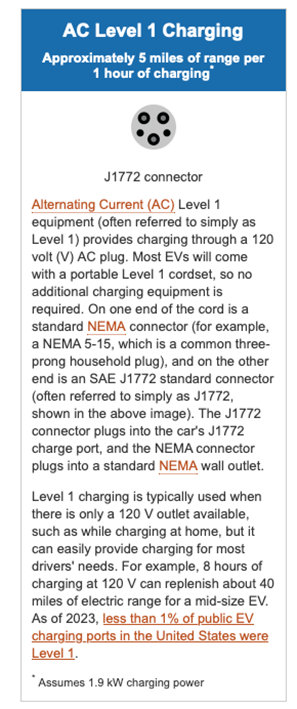
- AC Level 1 Charging
-
- Charge Rate: Approximately 5 miles of range per hour.
- Specifications: Utilizes a standard 120-volt outlet via a J1772 connector. Level 1 is primarily for home charging and requires no additional equipment.
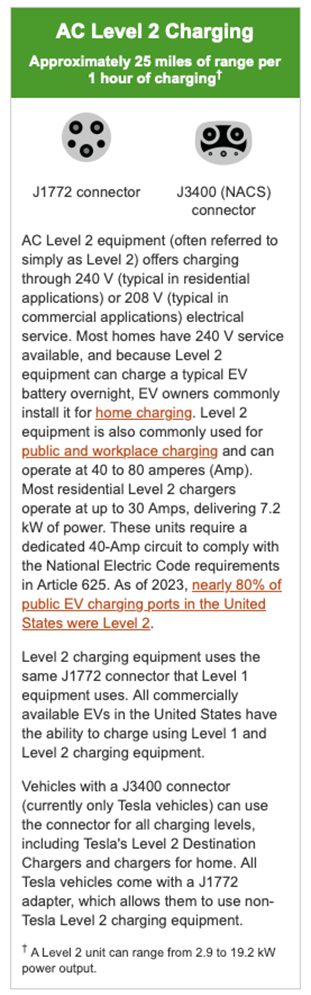
- AC Level 2 Charging
-
- Charge Rate: Approximately 25 miles of range per hour.
- Specifications: Operates on 240-volt electrical service (commonly used in residential settings). Predominantly installed for home and public charging stations, accounting for nearly 80% of public EV charging ports as of 2023.
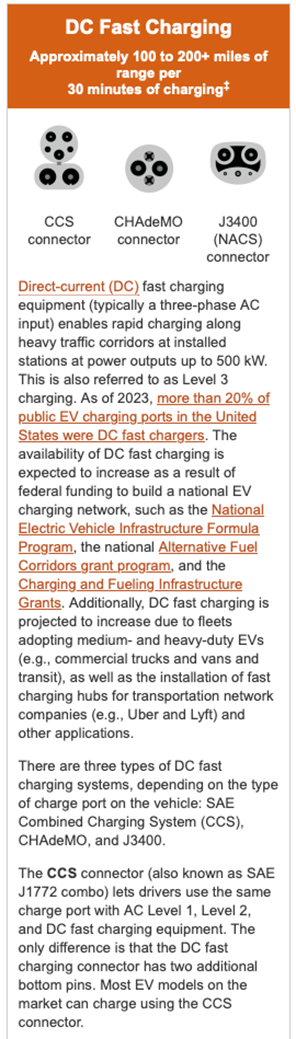
- DC Fast Charging
-
- Charge Rate: Approximately 100 to 200+ miles of range in 30 minutes.
- Specifications: Involves high-power charging stations capable of rapid charging along key transportation routes. About 20% of public EV charging ports are DC fast chargers, increasing due to federal funding initiatives.
 |  |  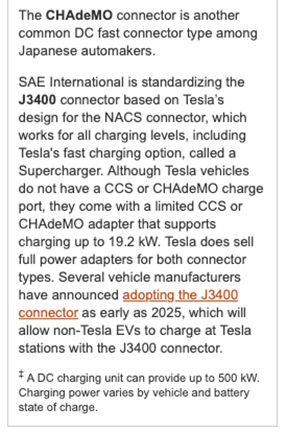 |
Source: U.S. Department of Energy Alternative Fuels Data Center (AFDC)
Career Pathways in EV Infrastructure
To support the growth of electric vehicle infrastructure, educational institutions should develop clear curriculum maps and program pathways that align with industry needs. Heartland Community College in Normal, Illinois, stands out as a leader in supporting the rapid expansion of the EV ecosystem. By partnering with companies such as Rivian and State Farm, Heartland has established innovative collaborations across the state to standardize training criteria, build unique partnerships, and create pioneering programs. Two of their newest apprenticeship programs include:
Laborer for Electric Vehicle Supply Equipment Technician: O*NET-SOC CODE: 47-2061.00
EVSE Technician: O*NET-SOC Code: 49-3023.00
Below is Heartland Community College’s curriculum map for its Electric Vehicle Supply Equipment (EVSE) Technician (O*NET-SOC Code: 49-3023.00) and Laborer for EVSE Technician (O*NET-SOC Code: 47-2061.00) apprenticeship programs.
| Course | Course Name | Credit Hours | Contact Hours |
|---|---|---|---|
| MAIN 101 | Industrial and Building Electricity and Systems | 3 | 45 |
| REEC 120 | Sustainability and Renewable Energy | 3 | 45 |
| REEC 234 | Battery Technologies | 3 | 45 |
| TECH 171 or TECH 172 OR TECH 271 or TECH 272 | 10-Hour OSHA Construction or General Industry Safety OR 30-Hour OSHA Construction or General Industry Safety | 1-2 | 15-30 |
| Total | 13-14 | 195-210 |
“Too long for the old days when a job had a straight forward meaning, where the tasks to be hired were known and clear. We might not know all of the requirements but we know getting into, say, a nursing program, we know where to start. We know a nurse works with people to make them well. We know there are many areas a nurse works at; a hospital, an advanced clinic, a prompt care, or even at a retirement home. We know what a nurse does and generally know they need to have a large toolbox of skills to be success at all levels. But we don’t realize all of the skills needed to move into more advanced careers in nursing.
EV charging and energy storage is no different. The EVSE and Energy Storage careers are just as deep and wide. A certificate in EV charging and Energy Storage is an entry certificate to get into industry. It says, I understand the foundations, can define terms and be able to apply my skills to assist in installation, wire up, and read schematics. I can even perform troubleshooting techniques to an EVSE or Energy Storage But I will need additional training to do higher technical maintenance applications. Skills in wiring, sizing, NEC requirements will be needed to do major installations. Or if I get into a company servicing these systems there is networking, net security, advanced troubleshooting and using advanced tools and analyzers will be needed to be able to understand the entire system from backend to front end.”
— Chris Miller, Industrial Technology Faculty at Heartland Community College, speaking on EVSE
YouTube Videos
Upskill with Electric Vehicle Technology at Heartland
Learn more about Heartland Community College’s expansion of the EV ecosystem
Heartland Community College Programming to Support the Expansion of the EV Ecosystem
Energy Systems Technology
The 22-credit Energy Systems Technology Skills Certificate program at Heartland Community College prepares students for an entry-level position such as a technician, integrator, installer, or energy auditor in a wide range of renewable energy fields. The certificate includes a wide variety of technologies to choose from such as building automation, wind energy, photovoltaic energy, energy storage and EV chargers. Focus is on basic skills in electrical systems, mechanical integration, installation and integration. With these skills, program completers can install, troubleshoot, and repair various renewable energy systems. All of the courses can be applied toward the Industrial Technology Certificate or the Industrial Technology AAS degree.
More information, including certificate requirements, is available here.
Associate in Applied Science – Industrial Technology
The Industrial Technology Associate of Applied Science degree prepares students for a variety of entry- to mid-level technician and/or operator positions in various industrial settings such as manufacturing, metalworking, construction, renewable energy, and fabrication. Students learn skills in technical graphics, safety, AutoCAD, and computer literacy, as well as skills in one or more industrial areas such as: construction, electronics, renewable energy, facilities maintenance, industrial maintenance, design and fabrication, and/or welding. Students may choose to specialize in one or more industrial areas by using technical elective hours to complete skills certificates as they work toward your degree.
More information about the program, including course requirements, is available here.
Promising Practices Highlight: Rivian
Rivian’s Blueprint for EV Education Partnerships with Community Colleges
As the automotive world rapidly electrifies, the demand for skilled electric vehicle (EV) maintenance technicians is skyrocketing. Rivian, recognizing the crucial role of a well-trained workforce, has established a model for partnering with community colleges to cultivate these essential skills. Their approach focuses on fostering robust collaborations that ensure training programs are effective, relevant, and sustainable.
Collaborate Early on Curriculum Development
Rivian emphasizes early and consistent engagement in curriculum design. They work directly with community college faculty and administrators to ensure that training programs are aligned with real-world industry demands. This collaborative approach ensures that students gain not only theoretical knowledge but also practical, job-ready skills, such as high-voltage safety, powertrain diagnostics, and battery management systems.
Rivian also champions a modular and flexible curriculum to accommodate students with diverse backgrounds, from recent high school graduates to experienced technicians looking to upskill. They support the creation of stackable credentials, allowing students to earn certifications that build toward a degree, providing clear pathways for career growth.
Invest in Specialized Equipment and Facilities
To provide authentic hands-on training, Rivian understands the importance of investing in state-of-the-art equipment and facilities. They actively support community colleges by donating or subsidizing EVs, battery packs, advanced diagnostic tools, and charging stations. This direct access to real vehicles and components is fundamental for effective training.
Furthermore, Rivian assists colleges in retrofitting labs and workshops to meet stringent safety standards for working with high-voltage systems. This commitment ensures student safety and prepares graduates for the specific work environments they’ll encounter in the field.
Support Faculty with Ongoing Professional Development
Rivian recognizes that instructors need to stay current with rapidly evolving EV technologies. They provide comprehensive faculty support and professional development opportunities, including train-the-trainer programs, access to proprietary technical documentation, and invitations for instructors to participate in job shadowing or short-term residencies at Rivian facilities.
This ongoing professional development ensures that instructors are proficient in emerging areas like advanced driver-assistance systems (ADAS), battery diagnostics, and grid integration, which maintains the credibility and relevance of the training programs.
Facilitate Work-Based Learning and Clear Career Pathways
A cornerstone of Rivian’s approach is integrating work-based learning to bridge the gap between classroom instruction and real-world application. They collaborate with community colleges to offer internships, apprenticeships, co-op programs, and job shadowing opportunities, providing students with invaluable practical experience and often leading to direct employment.
Rivian also helps define clear career pathways, from technician to engineer or from maintenance to management, illustrating the potential for advancement within the EV ecosystem. This clarity not only boosts enrollment and retention but also fosters long-term workforce engagement.
Support Student Outreach and Equitable Access
To cultivate a diverse EV workforce, Rivian actively participates in student outreach initiatives. They partner with community colleges on career fairs, school visits, and awareness campaigns that highlight the economic and environmental benefits of EV careers, aiming to attract a broad range of students, including those from underserved communities.
To reduce barriers to participation, Rivian supports initiatives that provide scholarships, stipends for internships, and transportation assistance. They also advocate for flexible program designs, such as evening or hybrid classes, to accommodate working learners or those with caregiving responsibilities.
Measure Outcomes and Adapt Continuously
Rivian’s partnerships are outcomes-driven, with clearly defined shared goals and key performance indicators like graduation rates, job placement rates, and employer satisfaction. They establish regular feedback loops between colleges and employers to identify skill gaps, track industry trends, and refine the program over time.
Data collection and analysis, including demographic information, are crucial to ensure equity in participation and outcomes. This information is vital for securing continued funding and for scaling successful models to other regions, further strengthening the EV workforce.
Training Programs
Two of the main content and training providers are the Electric Vehicle Infrastructure Training Program (EVITP) and SAE. Included below are their course overviews and links to receive more information about how to collaborate.
EVITP Overview
The EVITP program provides the most comprehensive training for the installation of Electric Vehicle Supply Equipment (EVSE) in North America today. More than a technical installation course, EVITP offers a full overview of the electric vehicle industry including an extensive section on Customer Relations & Customer Satisfaction
Developed in collaboration with industry, EVITP offers the perspective of automakers, utilities, EVSE equipment manufacturers and other key stakeholder associations. The EVITP collaborative understands the importance of the EV market being properly supported as it develops and expands. The electricians installing EVSE must understand the many aspects of the market today to adequately address customer questions, concerns and satisfaction.
The Electric Vehicle Infrastructure Training Program (EVITP) has rigorous instruction and training standards. Appropriate entry requirements, expert instruction, a comprehensive and regularly updated curriculum with a demanding final exam ensures strong comprehension, performance, and consistent training results.
Find the full course overview here.
SAE Programming Overview
Introduction to EV Infrastructure: Standards, Regulations & Safety Practices PD532329
As a new and emerging industry, EV charging infrastructure presents a large and complex domain for engineers who have little to no experience working in this area. What are the key EV charging standards that engineers need to know? What protocols do engineers need to understand? What are the regulations and how do they differ by region? How do these standards, rules, and guidelines interoperate to ensure reliable, interoperable, safe, and secure EV charging?
This course facilitates the use standards and best practices to build a foundation for how and when to use them. It will also introduce communication protocols that establish rules and guidelines for how EV Chargers (EVSE) operate and communicate. The course also includes global regulations according to geographic regions and how they impact engineering and business decisions.
Get the full course description, outline, and requirements here.
Other Training Resources
Currently, the following training options are available for those looking to prepare for the SAE EVSE Technician Certification:
- DiverseNote Mobility Electric Vehicle Systems
- Wake Tech EVSE Field Technician Program
- Women Who Charge EVSE Repair Training
Conferences:
Stay Involved
- Electric Vehicle Charging Infrastructure Trends
- Alternative Fueling Station Locator
- PlugShare – One of the most comprehensive EV charging station maps available
- Federal Laws & Incentives
- EVITP – Electric Vehicle Infrastructure Training Program – the most comprehensive training for the installation of Electric Vehicle Supply Equipment (EVSE) and offers a full overview of the EV industry.
- SAE International Electric Vehicle Supply Equipment (EVSE) Technician Certification – Certification program great for electricians
Industry Training Providers
Currently, the following training options are available for those looking to prepare for the SAE EVSE (Electric Vehicle Supply Equipment) Technician Certification:
- DiverseNote Mobility Electric Vehicle Systems
- Wake Tech EVSE Field Technician Program
- Women Who Charge EVSE Repair Training
Conferences: